

Visiting a golf course for the first time is always an exciting challenge. It doesn’t matter if you’re an experienced player or have only been playing for a few years: every course has its own personality and requires a different approach to the round.
It’s common to think that a good score depends solely on the quality of your swing or the distance you can hit with your driver. However, the reality is quite different. The players who adapt best to a new golf course aren’t necessarily the ones who hit the ball the hardest, but rather those who know how to read the course before making decisions.
Understanding how a course is laid out, identifying the risks, assessing the terrain, and adjusting your strategy starting from the first hole can make the difference between a round full of avoidable mistakes and a much more satisfying experience.
At Club Golf d’Aro, located in a stunning setting on the Costa Brava, each hole presents different challenges that encourage players to think carefully before taking each shot. It is precisely this variety that makes every round an opportunity to learn and enjoy the game.
Every golf course has its own personality
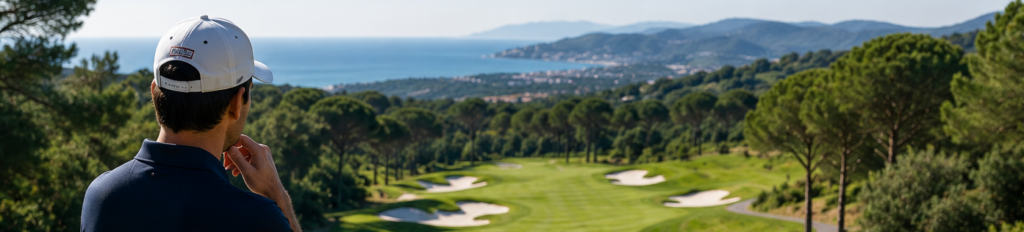
One of the most common mistakes is assuming that all courses are played the same way. Even though the rules are identical, the layout of the course completely changes the way each hole is approached.
The width of the fairways, the placement of the bunkers, the speed of the greens, the elevation changes, the vegetation, and even the course’s orientation relative to the wind give each course its own unique character.
For that reason, getting a feel for a golf course means much more than just knowing the distance of each hole. It involves understanding how the architect has designed each situation to force the player to make decisions.
Instead of always trying to impose our usual game, it’s better to spend the first few holes figuring out how the course plays. That information will be much more valuable than taking unnecessary risks right from the start.
Your first goal shouldn’t be to shoot your best round
Many players arrive at a new course with the intention of immediately posting a great score. That pressure often has the exact opposite effect.
When we don’t yet know how the ball bounces on the fairways, how the greens break, or which areas present the greatest challenges, taking unnecessary risks often leads to avoidable mistakes.
More experienced golfers understand that the first round serves another purpose: to get to know the course.
Every shot provides information. Observing how the ball rolls after landing, checking the consistency of the greens, or identifying which areas make it easiest to attack the flag are small details that will make a difference in future rounds.
That’s why, a lot of the time, a modest bet during your first visit ends up being an excellent investment that lets you play much better the next time.
Before you take a swing, pay attention to what the course is trying to tell you
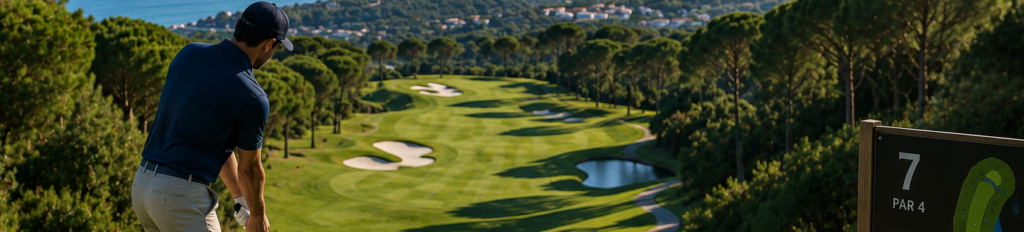
One of the best skills any golfer can develop is learning to observe before acting.
All too often, we walk up to the tee, automatically reach for the driver, and take the shot almost on autopilot. However, taking just a few seconds to analyze the hole can completely change your strategy.
Before deciding on a club, it’s worth considering factors such as:
- The actual width of the street.
- The location of the bunkers.
- The slope of the land.
- The location of the trees.
- Wind direction.
- The best spot from which to attack the green.
You’ll often find that the smartest shot isn’t the longest one, but the one that leaves the next ball in the most favorable position.
It is precisely these kinds of decisions that make it possible to build much more solid and consistent laps.
An architect never places a bunker by chance

There is a tendency to think that bunkers are there solely to punish bad shots. In reality, they serve a much more interesting purpose.
A good course designer uses obstacles to force the player to choose between different strategies.
On some holes, a bunker blocks the shortest route to the green, forcing players to decide whether to take a risk or play it safe.
In other cases, bunkers define the ideal area where the tee shot should land to make the next shot easier.
Understanding this approach completely changes the way you tackle the course. Instead of trying to avoid every obstacle, the player begins to consider why they are placed where they are and how they influence the strategy for the hole.
That shift in mindset usually leads to better decisions and, in the long run, to better results.
The biggest mistake: playing the same way you do on your usual course
When a golfer visits a new course, it’s very common for them to try to make exactly the same decisions they make at their usual club.
Always using the same club off the tee, going for every flag, or relying solely on known distances can become a problem when the course layout changes completely.
Each route requires a different approach.
There are courses where accuracy is much more important than distance. Others reward strategic play or heavily penalize mistakes off the tee.
Accepting that reality from the very first hole allows you to enjoy the experience much more and avoids unnecessary frustration.
In addition, discovering new ways to tackle a course also helps you grow as a player, since it forces you to break out of your routine and develop skills you might not normally use.
Don’t play against the course—play with it
One of the shifts in mindset that has the greatest impact on a golfer’s improvement is to stop “fighting” the course and start using it to their advantage.
Many players view any obstacle as an enemy: a bunker is a problem, a slope is a challenge, and a dogleg is an added complication. However, the most experienced golfers understand that the course’s design itself offers solutions if you know how to interpret it.
A slope can help you gain distance after the ball bounces. A slightly sloping fairway can guide the ball back toward the center if played on the right side. Even a bunker can serve as a visual reference to help you choose your target.
Instead of trying to force perfect shots on every hole, it’s much more effective to identify the options the course offers and choose the one that best suits your skill level.
This way of thinking reduces errors, builds confidence, and makes every decision make much more sense.
Five Questions You Should Ask Yourself Before Playing Each Hole

Before taking your first shot, take a few seconds to assess the situation. These five questions can help you make better decisions throughout your round:
1. Where exactly is the danger?
It’s not always the most obvious bunker. Sometimes the real risk lies in deep rough, a tree blocking the second shot, or a slope that sends the ball into a tricky area.
2. What is the best position for the next shot?
Many players focus solely on hitting the ball as far as possible. However, placing the ball in a good position to attack the green is often much more important than gaining a few extra meters.
3. If I fail, where would I rather do it?
Good players don’t just plan the perfect shot; they also consider the most likely mistake and choose the option that minimizes its consequences.
4. Is it worth taking the risk?
On some holes, it’s worth taking an aggressive approach. On others, playing it safe can prevent a completely unnecessary double bogey.
5. What is the hole’s layout trying to tell me?
The placement of hazards, the width of the fairway, and the orientation of the green are rarely random. Paying attention to these details helps you understand the strategy the course is designed to encourage.
Answering these questions in your head takes just a few seconds, but it can completely transform the way you approach a round on an unfamiliar course.
Patience is also part of the strategy
There’s a widely held belief among golf enthusiasts: if a hole seems easy, you should try to make the most of it. However, golf rarely rewards impatience.
When visiting a new course, it’s best to accept that you won’t uncover all its secrets on your first round. There will be greens that seem faster than expected, unexpected bounces, or distances that are misleading due to the elevation changes.
Far from getting frustrated, the best players use every hole to gather information. That attitude allows them to adjust their strategy as the round progresses and tackle the final holes with much greater confidence.
Ultimately, a first visit to a farm should not be viewed as a test, but rather as an opportunity to learn.
Club Golf d’Aro: A Course That Rewards Good Decisions
Every course has its own character, and one of the things that visitors to Club Golf d’Aro appreciate most is precisely the variety of challenges the course offers.
The changes in elevation, the varying orientations of the holes, and the combination of wide fairways with areas that demand greater precision mean that every shot calls for careful thought before execution.
It’s not just about hitting long shots. The course rewards those who know how to analyze each hole, choose the right club, and adapt their strategy to the conditions at the time.
If you’re not yet familiar with the course, you can find all the information in the Golf Coursesection, where you’ll find details about its features and facilities.
Also, if this is your first visit, you might find it helpful to read our article on how to choose the right tee based on your skill level,since choosing the right tee is the first step to fully enjoying any course.
Adapting to a new golf course isn’t just about knowing the distances to the holes or consulting the course map. It means learning to interpret the course layout, observing before acting, and understanding that every decision affects the final outcome.
The players who improve the fastest aren’t necessarily the ones who hit the ball the hardest, but rather those who know how to analyze the course, accept that each round presents different challenges, and adjust their strategy accordingly.
The next time you visit a course for the first time, take a few minutes to get a feel for it before trying to impose your usual game. You’ll find that golf is much more enjoyable when played with intelligence, patience, and the ability to adapt.
And if you’re looking for a course where every hole invites you to think, improve, and enjoy a unique setting, Club Golf d’Aro offers the perfect setting to continue growing as a golfer.